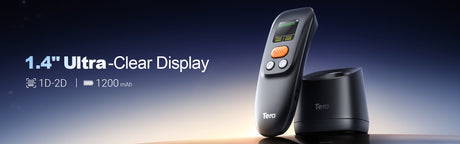
What exactly is a CCD barcode scanner, and why are more warehouses, retailers, and logistics teams making the switch? This technology uses a solid-state sensor to capture barcodes with speed and accuracy, helping you process transactions, track inventory, and manage shipments more efficiently—day after day.
If you’ve dealt with slow scans, frequent misreads, or unreliable hardware, CCD scanners offer a proven alternative that stays accurate even with worn labels or challenging lighting. In this guide, you’ll learn how CCD technology works, how it compares to laser and CMOS models, and how to choose the right device for your business. We’ll also cover real-world applications, troubleshooting tips, and expert buying advice so you can make a confident, cost-effective decision.
What is a CCD Barcode Scanner?
A CCD barcode scanner is a barcode reader that uses a charge-coupled device (CCD) sensor to take a snapshot of the entire code at once. Light from built-in LEDs reflects off the barcode’s black bars and white spaces, and a row of light-sensitive cells turns that pattern into digital data.
Because the scan engine has no moving parts, it stays fast and accurate for years with minimal maintenance. CCD scanners handle 1D barcodes like UPC, EAN, and Code 128, even when the print is worn or slightly damaged.
They are widely used in retail checkouts, warehouse inventory, and healthcare tracking, and can connect by USB for fixed setups or Bluetooth for mobile scanning.

How a CCD Barcode Scanner Works: Technology Explained for Business Use
When you trigger a CCD barcode scanner, a row of LED lights shines directly on the barcode. The white spaces reflect more light, while the black bars absorb it.
A CCD scan engine has hundreds of tiny light-sensitive cells arranged in a straight line. Each cell captures the light from a small slice of the barcode at the same time, like a row of miniature cameras taking one snapshot together. This full-width capture helps linear CCD/CMOS imagers reach ~200-650 scans per second, depending on the model.
The light each cell receives is turned into an electrical charge. These charges form an analog signal pattern, which passes through an analog-to-digital converter. The resulting digital data is sent to the decoder, which matches the light-and-dark pattern to the stored definitions of barcode symbologies such as UPC, EAN, or Code 128.
Because the scan engine has no moving parts, performance stays consistent over years of use. This design also allows for a stable accurate read range of a few centimeters to several inches, even with barcodes that are slightly worn, poorly printed, or scanned under uneven lighting.
CCD vs Laser vs CMOS: What Actually Differs
You want the fastest way to choose. Use the table, then match your scene.
|
Criterion |
CCD barcode scanner |
Laser barcode scanner |
CMOS 2D imager |
|
Reading method |
Linear CCD sensor captures the whole line at once |
A laser beam with oscillating optics scans a line |
Area CMOS sensor captures an image frame |
|
Codes supported |
1D barcodes such as UPC, EAN, Code 128 |
Primarily 1D |
1D and 2D, such as QR, Data Matrix, PDF417 |
|
Typical range |
Short to mid; best at close work |
Short to long; excels at distance |
Short to mid; depends on optics and resolution |
|
Print tolerance |
Strong on worn or low-contrast 1D labels |
Moderate; prefers clean, high-contrast labels |
Strong, including on screens and curved surfaces |
|
Motion tolerance |
Good for quick hand movement at close range |
Good at distance aiming |
Varies by sensor and exposure; modern units are solid |
|
Mechanics inside |
Solid-state engine; no moving assemblies |
Has moving assemblies |
Solid-state |
|
Longevity and upkeep |
Stable over years; minimal maintenance |
More maintenance over time |
Stable; firmware features evolve quickly |
|
Safety |
No laser emission |
Laser safety class applies |
No laser emission |
|
Common use |
POS counters, picking, healthcare ID |
High racks, longer reach, industrial aisles |
Mixed codes, mobile apps, on-screen scans |
Quick picks. Choose CCD for high-volume 1D work at the counter or on the cart, where reliability and label tolerance matter. Choose a laser when you must read 1D items from farther away without walking closer. Choose CMOS when you need both 1D and 2D barcodes, or frequent screen scans.
A note on CIS. Contact Image Sensor modules sit very close to the surface and are common in document scanners. In barcode use they behave like linear imagers with a shorter depth of field, so they fit flat, close-contact workflows rather than long-reach tasks.
Bottom line. If your workload is mostly UPC and Code 128 at close range and you value low upkeep, CCD barcode scanner is the efficient default. If your mix includes QR or on-screen codes, a CMOS 2D imager is the safer bet.
Key Advantages of CCD Barcode Scanners for Retail, Warehouse, and Logistics Efficiency

A CCD barcode scanner stands out for its accuracy, durability, and cost efficiency, making it a practical choice for high-volume 1D barcode tasks. Below is a quick look at the core strengths that set it apart in real-world use.
High accuracy on real-world labels: A CCD scanner reads 1D barcodes like UPC, EAN, and Code 128 with precision, even when the label is scratched or wrinkled. In a supermarket checkout, this means fewer rescans and faster customer flow.
Consistent speed under pressure: The scan engine can process hundreds of scans per second without slowing. In a warehouse, staff can move from pallet to pallet without pausing to wait for the device.
Durability for daily work: With no moving parts, a CCD scanner can handle years of drops and daily shifts. Think of it surviving peak shopping seasons without a single service break.
Low maintenance cost: The solid-state design needs minimal upkeep, which keeps service calls rare and downtime low. Over time, this saves both repair costs and lost work hours.
Cost-effective performance: Compared with high-end 2D imagers or laser units, a CCD offers strong results for most 1D workflows at a lower total investment. It’s ideal for teams balancing quality and budget.
Safe for continuous use: LED illumination replaces laser beams, so operators can work all day at close range without laser safety concerns.
Stable performance in variable lighting: From bright store aisles to dim stockrooms, or even in direct sunlight, the accurate read range ensures smooth scans. Many CCD/linear imagers can read 1D barcodes from electronic screens, adding flexibility for mobile tickets, coupons, and app-based barcodes.
Flexible connection options: Choose USB for fixed POS stations or a Bluetooth handheld for mobile scanning in aisles, storerooms, or medical wards.
Broad compatibility with barcode symbologies: Supports formats used in retail, logistics, and manufacturing, allowing one device to serve multiple roles in a single operation.
If you need accuracy, durability, cost control, and speed for 1D barcodes, a CCD barcode scanner delivers all of them with minimal upkeep, making it a reliable tool in retail counters, warehouses, and healthcare stations.

Main Application Scenarios and Industry Use Cases
CCD barcode scanners are used in retail, warehouse management, healthcare, manufacturing, logistics, and even libraries for fast, accurate reading of 1D barcodes such as UPC, EAN, and Code 128. They are specifically designed for linear barcodes and cannot read 2D formats like QR codes, making them versatile for both commercial and institutional workflows.
Retail checkout: At point-of-sale terminals, cashiers scan items quickly, even if labels are faded or scratched. The high read rate keeps checkout lines short and inventory records accurate.
Warehouse management: Operators use Bluetooth handheld CCD scanners for stock counts, picking, and asset tracking. Real-time data capture improves accuracy during large-scale audits and speeds up order processing.
Healthcare: Hospitals and clinics scan patient wristbands, medication labels, and lab samples. Reliable scanning in bright wards or low-light rooms supports safe identification and accurate records.
Manufacturing: On production lines, CCD scanners record product codes, part numbers, and batch IDs. They handle worn or oily labels, ensuring smooth quality control and traceability.
Logistics and transportation: At loading docks and delivery points, staff confirm shipments by scanning barcodes on parcels and pallets. The LED-based scan engine maintains accuracy even under outdoor lighting.
Education and libraries: Schools and libraries use CCD technology for lending, returns, and asset tracking. Transactions stay fast and easy for staff and users.
Modern CCD scanners support both contact and short-range scanning. Wireless and Bluetooth models provide mobility on warehouse floors or retail aisles. For businesses working with 1D and occasional 2D codes, they deliver an accurate read range and consistent scan rate whether docked at a terminal or used portably.
Across retail, logistics, and healthcare, companies report significant results. In warehouse inventory management, for example, standardizing on reliable barcode scanning technology has been shown to dramatically improve efficiency and reduce error rates—clear proof of its value in daily operations.
Key Factors When Purchasing a CCD Barcode Scanner
Choosing the right CCD barcode scanner requires evaluating several key factors, including communication interface, resolution and barcode support, scanning range and speed, system compatibility, durability, ergonomic design, power supply, software configurability, and after-sales service. Understanding these considerations will help you select a model that fits your workflow and delivers reliable performance over time.

1. Communication InterfaceMatch the connection type to your work environment.
- USB: Best for fixed point-of-sale stations.
- Bluetooth/Wireless: Ideal for warehouses, mobile inventory checks, and retail floor operations.
Recommendation: For flexible use, choose a model supporting both USB and Bluetooth.
2. Resolution and Barcode SupportHigher resolution enables accurate reading of dense 1D barcodes like UPC, EAN, and Code 128.Recommendation: Aim for at least 3–5 mil resolution if you handle small or high-density linear barcodes.
3. Scanning Depth of Field and Field of ViewA wide depth of field supports scanning at both close range and distances over 12–17 inches.Recommendation: For warehouse use, target 15–20 inches maximum read distance; for POS, 6–12 inches is sufficient.
4. Scan Speed and Motion ToleranceHigh scan rates improve performance in fast-moving workflows.Recommendation: Look for 200–300 scans per second and motion tolerance above 20 inches per second for conveyor or high-volume retail environments.
5. System CompatibilityEnsure integration with POS, WMS, or ERP software.Tip: Check driver availability for Windows, Android, and iOS to avoid future incompatibility.
6. Durability and Environmental ResistanceCCD scanners with no moving parts last longer and require less maintenance.Recommendation: For industrial or outdoor work, choose at least IP54 protection and 1.5–2 m drop resistance.
7. Ergonomic DesignComfortable grip, balanced weight, and light trigger pressure reduce operator fatigue.Recommendation: Weight under 200 g for all-day handheld use.
8. Power Supply Options
Corded for constant power, battery-powered for mobile work.Recommendation: Wireless models should have 8–12 hours of battery life per charge.
9. Firmware and Software ConfigurabilityCheck if the scanner supports programming barcodes for enabling/disabling symbologies, output formatting, and data prefixes/suffixes.
10. After-Sales Service and Warranty Look for multi-year warranties, fast replacements, and ongoing firmware updates.
Common Purchasing Pitfalls to Avoid
- Ignoring future needs: Buying a 1D-only scanner when your workflow may soon require 2D barcode support.
- Overlooking environmental resistance: Using a low-IP model in dusty or humid environments leads to early failure.
- Not checking software compatibility: Some low-cost models require third-party drivers or won’t integrate smoothly with your POS/WMS.
- Underestimating ergonomic impact: Heavy or poorly balanced models slow down operators in high-volume scanning tasks.
- Focusing only on price: A cheaper scanner with poor durability may cost more in replacements and downtime over time.
Leading Brands and Models of CCD Barcode Scanners
Choosing the right brand and model is just as important as knowing what specifications to look for. Below are four leading CCD barcode scanner brands, their flagship models, verified technical specs, and best-fit scenarios.
|
Brand |
Example Models |
Key Strengths |
Verified Specs |
Best Use Case |
|
Zebra |
CF-2KBW |
CCD technology; fast & accurate; reads poor-quality barcodes; stable in strong light |
CCD linear imaging; 1D codes; resolution up to 4 mil; USB/RS232; 0–50°C operating temp |
Retail checkout; warehouse/stockroom; ticket/label scanning; high-precision close range |
|
Honeywell |
Voyager 1250g |
High scan rate, extended read range, wide barcode compatibility |
IP41; 13-mil UPC up to ~17.6 in (446 mm); larger UPCs up to ~23 in (584 mm). |
High-volume retail checkout, logistics sorting, scanning large or distant barcodes |
|
Keyence |
HR-X series handheld code readers |
Exceptional precision, reads damaged or poorly printed codes, advanced optics |
Adjustable field of view; IP54+ |
Manufacturing quality control, industrial traceability, lab data capture |
|
Tera |
Wearable ring design, CCD screen scanning, 3-in-1 connectivity |
Connection: 2.4 GHz wireless + Bluetooth + USB 2.0; Battery: 400 mAh; Storage: 100,000 barcodes; Supported codes: UPC-A/E, EAN-8/13, Code 128, Code39, Code93, Code11, Codabar, MSI, RSS, China Post |
Mobile inventory, retail floor work, logistics where hands-free scanning improves efficiency |
How to Choose Based on Brand Strengths
- Zebra — Best for long-term, heavy-duty use in retail or warehouse environments where drop resistance and ergonomics matter.
- Honeywell — Ideal if speed and long-distance reading are priorities, such as in high-volume logistics or retail lines.
- Keyence — The go-to choice for precision scanning in manufacturing, quality control, and lab applications.
- Tera — Perfect for mobile workflows needing flexibility and hands-free operation, especially in retail floor or warehouse picking tasks.
Common Technical Issues and How to Fix Them
CCD barcode scanners are reliable, but occasional issues can slow down scanning. Most problems fall into four main categories: connection and interface errors, scan accuracy issues, configuration mistakes, and software/firmware faults.
1. Connection and Interface Errors
- Common causes: Loose USB cables, incorrect Bluetooth pairing, incompatible interface settings, or insufficient power supply.
- Quick check: Ensure cables are secure, Bluetooth is paired to the correct device, and the scanner is in the right interface mode (USB/COM/Bluetooth). Refer to your user manual for programming barcodes to reset modes.
2. Scan Accuracy Problems
- Common causes: Damaged or poorly printed barcodes, low-resolution printing, dirt on the scanner lens, or scanning outside the optimal range.
- Quick check: Clean the lens, test a new barcode, and scan within the recommended read distance. Verify that the barcode type (UPC, EAN, Code 128, etc.) is supported and enabled in the scanner settings.
3. Configuration & Symbology Settings: Some scanners ship with certain barcode symbologies disabled. If your scanner won’t read a code, check the manual to enable it via configuration barcodes.
4. Software and Firmware Issues: Outdated firmware can cause compatibility or performance problems. Visit the manufacturer’s website for updates, and ensure your POS or warehouse management software is configured to accept scanner input.
When to Contact Technical SupportIf basic troubleshooting fails—such as persistent misreads or integration errors—contact the manufacturer. For Tera scanners, technical resources include:
- Downloadable user manuals and configuration guides
- Firmware updates for performance improvements
- Online chat and email support for real-time assistance
Using these methods will help you quickly restore scanning speed, accuracy, and productivity, whether you’re running a retail POS or managing warehouse inventory.

Ready to Upgrade Your Scanning Workflow with CCD Technology?
If your business relies on fast, accurate barcode scanning—whether at retail checkouts, in warehouse aisles, or during on-the-go inventory checks—it’s time to put CCD technology to work for you.
Tera’s HW0011 CCD 1D Ring Barcode Scanner combines hands-free convenience, multi-mode connectivity, and reliable screen scanning into a compact, durable design. It’s built to handle high-volume 1D barcodes, even on worn labels or in challenging lighting, so your team can work faster and with fewer interruptions.
You’ve seen how CCD scanners outperform in accuracy, durability, and cost efficiency. Now you can experience it firsthand. Discover how Tera can transform your daily operations—start by exploring the HW0011 and other Tera CCD models today.