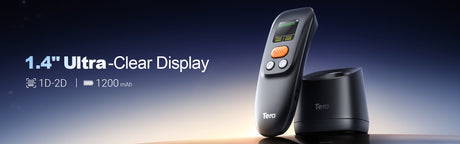
Ever wasted time waving your scanner around, hoping it will read a stubborn barcode? Or tried to scan from a phone screen only to have your POS freeze up? For anyone in retail, warehousing, or logistics, these delays cost more than just time—they hurt customer experience and slow your business down. Bluetooth 2D barcode scanners are built to fix that.
In this guide, we’ll start with what a Bluetooth 2D barcode scanner is, how it works, and how it’s different from 1D scanners or using your phone. You’ll learn the key features and specs that matter most, see where they shine in real-world industries, and find out why dedicated scanners beat smartphones in busy workflows. We’ll put Tera’s best model head-to-head with top competitors, show you how to connect to phones, tablets, and POS systems, and share practical scanning modes and tricks for faster work. Finally, our buying guide will help you pick the scanner that’s the right fit, so you can stop fighting with tech and start scanning smarter.
What Is a Bluetooth 2D Barcode Scanner?

A Bluetooth 2D barcode scanner is a wireless device that reads both 1D barcodes and 2D codes like QR codes. It uses imaging sensors to capture a barcode pattern, decode the data instantly, and send it to your phone, tablet, or computer via Bluetooth.
Here’s how it works: the scanner projects light onto the barcode, takes a digital image, runs it through a decoding algorithm, and transmits the result to your connected device. No cables, no fixed station—just point, scan, and send.
The difference between 1D and 2D scanning is in the data they capture. 1D scanners read simple, linear codes (like UPC or EAN) that hold limited information. 2D scanners read vertically and horizontally, decoding patterns such as QR codes or Data Matrix that store far more data and work even when printed small, curved, or damaged.
In short, a Bluetooth 2D barcode scanner combines broad barcode compatibility, cordless operation, and fast, accurate reads, making it a better fit for modern workflows than basic 1D models or smartphone camera apps.
How Much Data Can a 2D Barcode Hold with a Bluetooth Scanner?
A 2D barcode's capacity depends on the symbology. QR code (up to 4,296 alphanumeric/7,089 numeric) and Data Matrix ECC 200 (up to 2,335 alphanumeric/3,116 numeric) are common examples. This may include text, URLs, or encoded references to external resources like images or videos. The actual amount varies by format. For example, a QR Code can hold thousands of alphanumeric characters, while Data Matrix codes may offer higher density for small labels.
When paired with a Bluetooth 2D barcode scanner, you can capture this data instantly and send it to your phone, tablet, or computer without cables. This makes it ideal for applications that need compact but detailed information, such as product tracking, digital tickets, or asset management.
The key benefit is speed and mobility. You can scan a code containing large amounts of information from paper or a screen, transfer it wirelessly, and act on it immediately—without manual data entry. This is why 2D barcodes and Bluetooth scanners are a powerful combination for modern inventory, retail, and logistics work.

Core Features & Technical Specifications of Bluetooth 2D Barcode Scanners
Choosing the right Bluetooth 2D barcode scanner starts with understanding its key functions and specs. Below are the features that directly impact speed, accuracy, and ease of use in real workflows.
Scanning Accuracy & Speed: Equipped with CMOS, CCD, or dual-sensor modules for quick, precise reading of 1D and 2D barcodes. Dual-mode scanners handle damaged or low-contrast codes with ease. Ideal for fast checkout, warehouse picking, and inventory audits.
OS Compatibility: Works with iOS, Android, Windows, and Mac. Easily connects to smartphones, tablets, laptops, and POS systems, whether in retail, logistics, or healthcare.
Wireless Connectivity: Supports Bluetooth (range varies by device - e.g., up to 100 m for Class-1 models; many consumer models around 10-35 m) and/or 2.4GHz dongle connection. Perfect for mobile or fixed operations.
Screen Scanning Capability: Reads barcodes and QR codes directly from phone or tablet screens. Useful for mobile tickets, digital coupons, and app-based transactions.
Battery Life & Charging: Long-lasting battery for up to 12 hours of continuous use. Quick charging via cable or smart base keeps downtime minimal.
Rugged Design: IP42-IP67 protection against dust and water depending on model. Drop resistance up to 1.8 m ensures reliable use in warehouses, outdoor sites, and busy retail floors.
When choosing a model, match the scan engine, wireless range, and durability to your work environment to get the best performance.

Main Applications of a Bluetooth 2D Barcode Scanner
A Bluetooth 2D barcode scanner works across many industries, offering faster, more accurate scanning than a phone and more versatility than a 1D scanner. Below are the key use cases, each showing how wireless connectivity and 2D decoding improve workflow.
Retail & POS (including Square): In retail, a Bluetooth barcode scanner for Square lets staff scan items anywhere, update prices, and complete mobile checkouts. Wireless scanning reduces queues and improves customer experience.
Warehouse & Inventory Management: A wireless 2D barcode scanner speeds up cycle counts, stock updates, and picking tasks. Dual-band Bluetooth or 2.4GHz ensures stable data sync with warehouse management systems.
Logistics & Package Tracking: For couriers and distribution centers, Bluetooth barcode scanners for Android or iPhone make package sorting and delivery confirmation faster and more reliable, even for damaged or low-contrast codes.
Healthcare & Pharmaceutical Tracking: Scan patient wristbands, prescriptions, or lab samples instantly. IP-rated, disinfectant-ready scanners improve safety and traceability.
Manufacturing & Quality Control: Rugged wireless barcode scanners track parts, verify assembly steps, and log quality checks—even in dusty or humid environments.
Events & Ticketing: A Bluetooth 2D barcode scanner for phone quickly validates QR codes on printed tickets or mobile screens, enabling faster entry at events.
Asset Management & Audits: Schools, offices, and government agencies use portable scanners to log equipment during audits—faster and with fewer errors.
E-commerce & Amazon Sellers: Amazon accepts 2D barcodes for FBA box-content labels; item labels still require FNSKU/UPC/EAN unless exempted. A Bluetooth 2D barcode scanner lets sellers list, verify, and manage inventory without being tied to a desk.
Why It Matters: Across all these industries, a wireless 2D scanner keeps your workflow moving—faster than a phone, more capable than a 1D scanner, and built for long shifts. For proven reliability, Tera’s Bluetooth barcode scanners deliver stable connections, wide barcode compatibility, and rugged durability.
Bluetooth 2D Barcode Scanner vs Smartphone Scanning

Smartphones can scan 2D barcodes using built-in cameras or apps, but in high-frequency, professional use, dedicated Bluetooth 2D barcode scanners deliver far better results. They offer faster read speeds, higher accuracy, and reliable performance even with damaged, low-contrast, or tiny codes.
Smartphones often face issues like glare when scanning screens, slow processing, battery drain, and overheating after continuous use. They are also less rugged, making them unsuitable for warehouses, logistics, or outdoor operations.
Bluetooth 2D barcode scanners are purpose-built for high-volume, all-day scanning. With Bluetooth 5.0, 2.4GHz wireless, and USB options, they maintain stable connections up to 35m, work in dust, water, and extreme temperatures, and integrate directly with POS, WMS, or ERP systems via SDK/API. Many models support screen scanning without reflection issues, plus hot-swap batteries or smart base charging for zero downtime.
Quick Comparison
|
Feature |
Bluetooth 2D Barcode Scanner |
Smartphone Scanning |
|
Scan Speed & Accuracy |
Reads 1D & 2D codes in milliseconds, even damaged or low-contrast labels |
Slower, struggles with damaged or tiny codes |
|
High-Volume Use |
Designed for continuous scanning without overheating |
Battery drain and overheating after extended use |
|
Ruggedness |
IP-rated, drop-resistant, works in dust, water, and extreme temperatures |
Fragile, not built for harsh environments |
|
Connectivity |
Bluetooth 5.0, 2.4GHz, USB; stable long-range up to 35m |
Scanning is local; network needed for app sync/back-office updates |
|
On-Screen Scanning |
Optimized for scanning from phone/tablet screens |
Glare and reflection often cause failures |
|
Battery Life |
All-day battery, hot-swap or smart base charging |
Shorter runtime, drains main phone battery |
|
Business Integration |
Direct link with POS, WMS, ERP via SDK/API |
Requires third-party apps, limited system integration |
Bottom line: If your work involves frequent scanning, demanding environments, or system integration, a Bluetooth 2D barcode scanner is the professional choice.
Bluetooth 2D Barcode Scanner Comparison: Tera vs Other Brands
If you want a wireless 2D barcode scanner that balances speed, accuracy, and versatility, the Tera D6100 Pro is an all-round performer. It combines 3-in-1 connectivity (Bluetooth, 2.4GHz, USB), a global CMOS imaging engine for high-density and reflective codes, and a 2200 mAh battery for up to 12 hours of continuous scanning. Its physical power switch prevents accidental activation, and the wall-mountable stand enables hands-free scanning—features you rarely see together in one device.
|
Feature |
Tera D6100 Pro |
Zebra DS2278 |
Honeywell Voyager 1472g |
Socket Mobile S740 |
|
Scan Engine |
Global CMOS Imaging, reads 1D/2D & high-density codes |
2D imager |
2D imager |
2D imager |
|
Connectivity |
Bluetooth 5.0, 2.4GHz, USB |
Bluetooth, USB |
Bluetooth, USB |
Bluetooth, USB |
|
Range |
Up to 328ft (2.4G, open) / ~114ft (2.4G with obstacles); Bluetooth varies by host/environment |
~33 ft |
~33 ft |
~33 ft |
|
Battery Life |
12 hrs scanning, standby up to 720 days |
14 hrs |
14 hrs |
9 hrs |
|
Special Features |
Wall-mountable stand, battery indicator, adjustable volume |
Cradle charging |
Rugged build, IP42 |
Lightweight, pocket size |
|
Durability |
IP54, 6.6 ft drop resistance |
IP42 |
IP42 |
IP54 |
|
Price Range |
Mid-range |
High |
High |
Mid-high |
Tera 1300 Mini Pocket 2D Scanner: For maximum portability, the 1300 fits in your pocket while supporting Bluetooth, 2.4GHz, and USB. It includes vibration alerts for silent work, time prefix/suffix for scan timestamping, and offline storage for up to 20,000 barcodes, making it perfect for mobile sales, pop-up stores, and field inventory.
Tera CS7219i-BT Industrial 2D Scanner: For extreme environments, the CS7219i-BT brings global shutter megapixel imaging and DPM code reading for etched, curved, or reflective surfaces. It runs up to 25 hours on a 2600 mAh battery and withstands temperatures from -20°C to 60°C, making it ideal for manufacturing, logistics, and outdoor operations.
Bottom line: Choose D6100 Pro for the best balance of performance and versatility. Go for 1300 if you need mobility in tight spaces, or CS7219i-BT for industrial-grade durability and specialized code reading. All Tera models support 1D and 2D barcodes, work with Windows, macOS, iOS, and Android, and deliver consistent, accurate scanning for professional workflows.
How to Connect a Bluetooth 2D Barcode Scanner to Your Phone or Computer
Connecting your Bluetooth 2D barcode scanner takes just a few steps. Follow the guide for your device type.

Connecting to iPhone
- Turn on the scanner and make sure it is in Bluetooth mode.
- On your iPhone, go to Settings > Bluetooth and turn Bluetooth on.
- Wait for the scanner name to appear in the device list.
- Tap the scanner name to pair.
- Open a notes or POS app to test scanning.
Connecting to Android
- Turn on the scanner and switch to Bluetooth mode.
- On your Android phone, go to Settings > Bluetooth.
- Select the scanner from the available devices.
- Confirm pairing if prompted.
- Test by scanning a barcode into a text field.
Connecting to Square or POS Systems
- Follow the steps above for your phone or tablet.
- Open the Square app or your POS software.
- Go to settings and enable external barcode scanner support.
- Scan a test product to confirm the connection.
Troubleshooting Connection Issues
- Scanner not showing up: Make sure it is in pairing mode and Bluetooth is on.
- Pairing fails: Restart both the scanner and your device, then try again.
- Scanner works in Notes but not POS: Check POS settings for scanner input compatibility.
- Frequent disconnections: Stay within the recommended Bluetooth range and avoid interference.

How to Use a 2D Wireless Barcode Scanner
Before starting, make sure your 2D wireless barcode scanner is charged, paired, and set to the correct connection mode.
Manual Trigger Mode: Press and hold the scan button to read a barcode. Release to stop scanning. Best for targeted, single-item scanning.
Auto-Sensing Mode: Place the scanner in auto-sensing or presentation mode via settings or by scanning the setup barcode in the manual. The scanner will automatically detect and scan when a barcode is in range. Ideal for checkout counters.
Desktop Presentation Mode: Mount the scanner on a stand. Simply pass items in front of it for hands-free scanning. Useful for retail or POS environments.
Continuous Scanning Mode: Activate continuous scan in settings. The scanner keeps reading without pressing the button. Good for bulk barcode processing, but turn off when not in use to save battery.
Screen Scanning Tips: Hold the scanner 15–25 cm from the phone or tablet screen. Reduce screen brightness if glare affects reading. Ensure the code is fully visible and not distorted.

Buying Guide – How to Choose the Right Bluetooth 2D Barcode Scanner
Choosing a Bluetooth 2D barcode scanner comes down to your work setting, the codes you scan, and your budget. Focus on the essentials, and you will find the right model faster.
If you work in retail or POS, choose a light, compact scanner with screen scanning for phone-based QR codes and payments. For warehouse and logistics, a rugged model with a long wireless range and strong battery is key. In healthcare, go for disinfectant-safe, IP-rated units for sterile environments. For manufacturing, pick an industrial-grade scanner with drop resistance and high accuracy on curved or worn surfaces.
If you only scan 1D codes like UPC or EAN, an entry-level device works. For mixed 1D and 2D codes including QR or Data Matrix, choose a full 2D scanner. If you scan from phone or tablet screens, make sure the model supports LCD display scanning.
Match connectivity to your workflow. Bluetooth gives mobile freedom. USB wired is stable for fixed counters. 2.4GHz wireless is ideal for long-range, instant connection without pairing.
Durability matters in tough environments. Look for IP65 or higher sealing against dust and water. A scanner that survives a 1.5m drop will handle most warehouse floors.
Budget ranges are simple. $50–$100 suits light retail. $100–$200 fits professional multi-use scanning. $200+ buys industrial durability and advanced features.
If you are unsure, choose a 3-in-1 wireless 2D scanner with Bluetooth, 2.4GHz, and USB. It covers most needs without compromise.

Ready to Choose Your Bluetooth 2D Barcode Scanner?
You’ve seen how Bluetooth 2D barcode scanners can transform the way you work. The next step is simple: choose a trusted solution that keeps your workflow fast, accurate, and hassle-free.
Tera is here to help you make that choice with confidence. Visit our official store or contact our team to get personalized recommendations and start scanning smarter—today.