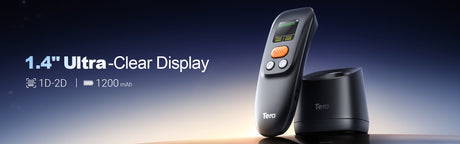
Tired of barcode scanners that keep you stuck at a desk? A wireless USB scanner gives you the freedom to move and scan anywhere you work. No cables. No pairing menus. Just plug in the USB receiver and go.
In this guide, we explain what a wireless USB scanner is and how it works. You’ll also see how it compares to wired and Bluetooth models so you can choose what fits best.
We cover the main scanner types—from laser to 2D imagers to hands-free setups. Then, we break down key features to consider, like battery life, scan speed, barcode support, and device compatibility.
Need help picking one? We review four popular models in 2025, each chosen for different needs like warehouses, retail, and portability. We also walk through common setup and troubleshooting tips to make sure your scanner runs smoothly.
If you want a reliable scanner that’s fast, simple, and easy to use, you’re in the right place.
What Is a Wireless USB Barcode Scanner and How Does It Work?

A wireless USB barcode scanner is a barcode reader that connects to a computer using a USB receiver. It sends data wirelessly over a 2.4GHz radio signal instead of using a cable.
The scanner pairs with the device when you plug in the USB dongle. Once connected, every scan is instantly sent to your screen, just like typing with a keyboard. Most models work right away without installing software.
Compared to Bluetooth, wireless USB scanners offer faster pairing and more stable signals. They don’t require navigating Bluetooth menus. But they usually only pair with one device at a time.
These scanners are ideal for retail, warehouses, and offices. If you want something simple, fast, and reliable, a wireless USB scanner is a smart choice.
Wireless vs Wired Barcode Scanners: Key Differences

The biggest difference between wired and wireless barcode scanners is how they connect and where they work best. One is fixed. The other moves with you.
Wired barcode scanners connect to a computer or POS system using a USB or RS232 cable. They rely on a physical connection for both power and data transmission. This makes them extremely stable and ideal for use in checkout counters, office desks, or environments where the scanner never needs to move.
Wireless barcode scanners, on the other hand, connect using a 2.4GHz USB dongle or Bluetooth. These scanners are battery powered and allow complete freedom of movement. You can scan across warehouse aisles, restock shelves, or check inventory in storage without being tied to a workstation.
Connection and Mobility
Wired scanners are plug-and-play but static—you must stay close to the terminal. Wireless scanners let you move freely, often up to 100 meters, depending on the model.
Stability vs Flexibility
Wired models are more stable, especially in busy environments with a lot of devices. But wireless scanners provide unmatched flexibility for mobile workflows.
Use Case Scenarios
- Wired: Retail counters, pharmacies, office check-in points.
- Wireless: Warehouses, logistics, mobile sales, inventory audits.
Power and Charging
Wired scanners don’t need batteries. They run constantly. Wireless scanners need to be charged regularly, but most offer long battery life for full-shift use.
Price and Setup
Wired scanners are usually more affordable and easier to maintain. Wireless scanners cost more but improve efficiency and reach, especially when scanning happens away from a fixed terminal.
USB vs Bluetooth
Many buyers ask: which is better, USB wireless or Bluetooth?
USB wireless scanners are faster to set up—just plug in the dongle and start scanning. Bluetooth scanners are more versatile, especially for pairing with smartphones or tablets, but may take longer to connect and sometimes have compatibility issues with certain operating systems.
Bottom line: Choose wired when your scanning happens at a desk or checkout. Choose wireless if your team moves around, scans far from the PC, or needs to work hands-free.
Common Types of Wireless USB Barcode Scanners Explained
Wireless USB barcode scanners come in different types based on how they read barcodes and how they connect. Below are the most common types, with quick highlights of their features and ideal use cases.

Laser Wireless USB Scanners
Laser scanners use a beam of light to read 1D barcodes. They’re fast and accurate at a distance, even on curved surfaces like bottles.
Best for: Retail checkouts, healthcare, or environments with traditional printed barcodes.
Avoid if: You need to scan 2D codes like QR or DataMatrix.
Linear Imager (CCD) Scanners
These scanners take a quick image of the barcode instead of using a laser. They’re more durable and better for close-range scanning.
Best for: Offices, POS systems, or short-range scanning tasks.
Avoid if: You need to scan from long distance or require flawless performance when scanning from screens (a 2D imager is often better for screens).
2D Imager Scanners
2D imagers read both 1D and 2D barcodes—including QR codes—by capturing a full image. They work on screens, damaged labels, or curved surfaces.
Best for: Warehouses, logistics, inventory management, and mobile POS.
Avoid if: You only need basic 1D scanning and want to save cost.
Hands-Free or Presentation Scanners
These scanners sit on a counter and scan automatically. They’re typically used with a wireless USB dongle for easy setup on laptops or POS systems.
Best for: Supermarkets, self-checkout kiosks, and pharmacy counters.
Avoid if: You need mobility or handheld scanning.
Quick Comparison: Which One Fits Your Workflow?
|
Scanner Type |
Reads 2D? |
Best For |
Key Strength |
|
Laser |
No |
Retail, healthcare |
Long-range accuracy |
|
Linear Imager |
No |
POS, office |
Durability, speed |
|
2D Imager |
Yes |
Inventory, logistics, screen scan |
Versatility |
|
Hands-Free |
Varies |
Checkout counters |
Fast workflow |
If you're using the scanner for inventory tasks, a 2D imager with USB-C compatibility is often the best fit. For simple barcode entry on a laptop, a basic laser scanner with USB dongle will do the job.
What to Look for in a Wireless USB Barcode Scanner
When buying a wireless USB barcode scanner, focus on seven things: connection type, barcode compatibility, battery life, scan range, durability, platform support, and price. These features decide whether a scanner fits your workflow, or slows it down.
Connection Type: USB-A, USB-C, Bluetooth, or 2.4G Wireless
Most wireless USB scanners use a 2.4GHz dongle that plugs into a USB port. Some models include both USB-A and USB-C, so you can use them with tablets, laptops, and desktops.
Bluetooth scanners work without a dongle and pair with smartphones or tablets. These are flexible but may reconnect more slowly or suffer interference.
If you switch between mobile devices and computers, a dual-mode scanner with Bluetooth and USB wireless is the safest choice.
Barcode Support: 1D and 2D
1D scanners handle barcodes like UPC, EAN, and Code128—perfect for simple retail tags or shipping labels. 2D scanners are more versatile. They can read QR codes, Data Matrix, and even barcodes displayed on a phone screen. If you scan IDs, digital tickets, or mobile coupons, 2D is a must.
Battery Life
Battery power affects how long your scanner runs in the field. Look for a model that supports at least 8 hours of continuous use. Some scanners also include sleep mode or auto-off to save power.
Scan Range and Speed
Retail users often scan close-up, but warehouse teams may need longer range. Entry-level scanners read from 5 to 30 cm. Advanced models reach 80 cm or more. Speed also matters. Some scanners process over 20 scans per second, helping you move faster at checkout or during inventory checks.
Durability and IP Rating
If you use your scanner in a store or office, a lightweight body is enough. For warehouse or outdoor use, go for rugged models with an IP54 or higher rating and protection against drops.
Device Compatibility
Make sure the scanner connects to your actual setup. Most wireless USB scanners work with Windows and Mac, and many also support Android tablets and POS systems. Not all scanners work well with iOS, so check first.
Price Range
You can find a basic 1D scanner for under $50, ideal for small retail counters. Mid-range scanners around $80 to $120 offer 2D scanning, better build, and dual connectivity. Enterprise scanners above $150 deliver industrial-grade features like drop resistance, large batteries, and fast processors.

Best Wireless USB Barcode Scanners for Different Needs (2025 Picks)
Looking for the best wireless USB barcode scanner for your workflow? Whether you're managing high-speed warehouse tasks or scanning at a retail counter, here are four top-rated models for 2025:
- Tera 8300Pro for industrial-grade DPM scanning
- Tera D5100 for warehouse and inventory
- Zebra DS2278 for low-cost, long-range scanning
- Datalogic RIDA DBT6400 for pocket-sized scanning on the go
Each one offers a unique mix of scan capability, wireless range, and durability, so you can find the best fit for your team or business setup.
Tera D5100 – Best for Warehouse and Retail Inventory
The Tera D5100 offers 2.4GHz wireless and USB wired modes in one compact scanner. It reads both 1D and 2D barcodes, including QR codes, PDF417, and Aztec. The 328 ft transmission range and plug-and-play design make it ideal for warehouse setups with no extra software needed. A 2000mAh battery powers extended shifts, and the battery level indicator helps prevent unexpected downtime. With IP54 protection and an anti-shock silicone cover, it's built to survive harsh work environments.
Best for: Inventory scanning in warehouse or stockroom settings
Why choose it: Long-range wireless, 2D support, no setup hassle
Tera 8300Pro – Best for High-Precision Industrial Scanning
The Tera 8300Pro is engineered for scanning in demanding sectors like automotive, aerospace, and healthcare. It features a 1-megapixel global shutter, capable of reading laser-etched and damaged DPM codes on curved or metal surfaces. With Bluetooth, 2.4G, and USB connectivity, plus NFC quick profile switching, it adapts instantly across users and tasks. It’s rated IP66 and survives 9.8 ft drops, perfect for rugged field use. The 2200mAh battery supports up to 33 hours of runtime.
Best for: Industrial part tracking in manufacturing and repair
Why choose it: Precision scanning on metal, NFC profiles, extreme durability
Zebra DS2278 – Budget-Friendly Wireless USB Barcode Scanner
The Zebra DS2278 is a cost-effective wireless USB barcode scanner designed for retail counters and light warehouse operations. It supports both 1D and 2D barcodes, including QR codes on screens, and features Bluetooth “Scan-to-Connect” for instant pairing. With a scanning range of 0.5″ to 14.5″ and PRZM intelligent imaging, it delivers fast, accurate reads even on poor-quality labels. The battery lasts a full shift, while the IP42 sealing and 1.5 m drop resistance ensure durability.
Best for: Affordable, reliable scanning in retail or stockroom environments.
Why choose it: Dual 1D/2D capability, fast omnidirectional scanning, and robust build.
Datalogic RIDA DBT6400 – Portable Bluetooth Barcode Reader
The Datalogic RIDA DBT6400 is a compact Bluetooth barcode reader ideal for mobile retail, event check-ins, and on-the-go inventory tasks. Weighing only 85 g, it offers a 25 m Bluetooth range and connects easily to smartphones, tablets, or PCs. It reads both 1D and 2D barcodes, including low-contrast and on-screen codes, using a white-illumination aimer with vibration feedback for precision in noisy environments. The 700 mAh battery supports up to 3,000 scans per charge and recharges in about 2.5 hours.
Best for: Portable scanning with flexibility and high accuracy.
Why choose it: Lightweight, versatile 1D/2D scanning, and ergonomic design.
Why Tera Makes the Better Business Choice
Choosing a wireless USB barcode scanner isn't just about specs—it’s about how well the device fits your real work. Many brands offer decent scanning, but Tera goes further in key areas that matter for long-term productivity:
- Better support for demanding workflows. From warehouse inventory to industrial tracking, Tera devices like the D5100 and 8300Pro are designed to handle high-volume scanning with less downtime.
- Built for durability and control. With IP-rated protection, customizable scan settings, and smart battery indicators, Tera scanners are made to stay reliable under pressure—not just in perfect lab conditions.
- More flexibility in real environments. NFC-based profile switching, multi-device pairing, and offline modes let teams adapt quickly without tech bottlenecks.
While budget models and enterprise names offer their strengths, Tera balances performance, usability, and cost with fewer trade-offs.
If your priority is real-world efficiency without complexity or inflated pricing, Tera stands out as the smart, scalable option.
Using and Troubleshooting Wireless USB Barcode Scanners
Even the simplest barcode scanner can cause frustration if it won’t connect, scan properly, or behave the way you expect. Here are the most common issues users face—and how to fix them.
What’s the proper way to link a wireless USB scanner with a computer?
Just plug in the USB receiver and power on the scanner. Most wireless USB scanners use a 2.4GHz dongle for instant pairing. There's no driver to install—just insert the dongle into your laptop or PC, turn on the scanner, and it connects automatically. Some models require you to scan a setup barcode once during first use.
Why won’t my scanner pick up barcodes?
It’s likely due to low power, bad pairing, or unsupported code type. First, check that the scanner is fully charged and turned on. If the connection light is off or blinking, re-pair it with the USB receiver. Also make sure you’re scanning a supported barcode type—1D-only models can't read QR codes. Switching scan mode or resetting the scanner often fixes the problem.
Can I use one wireless scanner with two devices at the same time?
No, most 2.4GHz USB scanners connect to only one device at once. The scanner links directly to its USB dongle, forming a one-to-one connection. If you need to switch devices, you’ll have to unplug the receiver and move it. Want true multi-device pairing? Look for a Bluetooth barcode scanner that supports device switching.
How do I scan QR or 2D barcodes with this kind of scanner?
Make sure your scanner supports 2D imaging before you try. Some wireless USB scanners are limited to 1D codes like UPC and Code128. To scan QR codes or Data Matrix, your scanner needs a 2D imager. Models like the Tera D5100 are designed for this. If you already have a 2D-capable model, just aim and scan—no extra steps needed.
Which is more stable—Bluetooth or wireless USB?
Wireless USB usually offers a more reliable signal for fixed workstations. 2.4GHz USB scanners tend to have fewer drops and quicker pairing in stable environments like warehouses or retail counters. Bluetooth scanners are more flexible for mobile setups, but may suffer interference or slower reconnection times, especially around other Bluetooth devices.

Find the Right Wireless USB Scanner for Your Workflow
Choosing a barcode scanner isn’t just about specs—it’s about how smoothly it fits your actual tasks. Whether you're scanning 1D barcodes at the checkout or managing 2D data in a fast-paced warehouse, the right tool can streamline your entire operation.
Tera offers scanners built for real work: from lightweight pocket devices to rugged models with NFC profile switching and industrial DPM support. If you're still comparing Bluetooth and 2.4G, USB-A and USB-C, or wondering what fits your POS system best, we're here to help.
Ready to simplify your scanning setup? Talk to our experts or explore our latest models tailored to your industry needs.